Nothing
README.md
In ravetools: Signal and Image Processing Toolbox for Analyzing Intracranial Electroencephalography Data
ravetools



ravetools is the signal- and image-processing toolbox behind RAVE, a
software suite for analyzing intracranial Electroencephalography
(iEEG) data.
It is deliberately a mathematical toolbox rather than an analysis
pipeline. It supplies the fast, memory-efficient primitives - filters,
spectral decomposition, image registration, surface geometry - and
leaves the user-facing pipelines to the other RAVE packages built on
top of it. Every routine is a plain function operating on plain R
objects.
Highlights:
- Memory-efficient
Notch filter, Welch periodogram, and Morlet
wavelet that scale to hours of high-resolution recording
- Single-pulse electrical stimulation analysis:
CARLA re-referencing,
canonical response parameterization, and basis profile curves
FIR and IIR filter design driven by a specification instead of a
filter order, with stability diagnostics- Self-contained 3D image registration (
rigid, affine, and SyN)
that depends on no external registration library
- Surface reconstruction, re-meshing, inflation, curvature, and
collision detection
- 3D mesh rendering in base R, with no
rgl dependency
- Parallel
C++ array primitives and direct access to FFTW3
What is inside
| Part | Contents |
|:---|:---|
| 1. Signal processing | Channel diagnosis and time-frequency decomposition; brain stimulation tools; filter design |
| 2. Image processing | 3D volume registration and resampling; surface reconstruction and rendering; low-level geometry |
| 3. Utilities and helpers | FFTW3 bindings, parallel array operations, geometry classes, binary readers |
The complete function reference lives at
dipterix.org/ravetools.
Installation
The package is on CRAN. To install the compiled version, simply run:
install.packages("ravetools")
Development builds are on r-universe:
install.packages("ravetools", repos = "https://dipterix.r-universe.dev")
Installing from source needs a C++ compiler, the
FFTW3 library, and pkg-config - nothing
else. See this
document
for platform-by-platform instructions.
1. Signal processing
1.1 Data analysis and diagnosis
The starting point for a channel is usually to look at it, clean the
line noise, and decompose it in time and frequency.
Generate a toy channel and inspect it. diagnose_channel combines the
trace, the Welch periodogram, and the histogram into one figure:
library(ravetools)
set.seed(2023)

# Generate 20 second data at 2000 Hz
time <- seq(0, 20, by = 1 / 2000)
signal <- sin( 120 * pi * time) +
  sin(time * 20*pi) +
  exp(-time^2) *
  cos(time * 10*pi) +
  rnorm(length(time))

diagnose_channel(signal, srate = 2000)
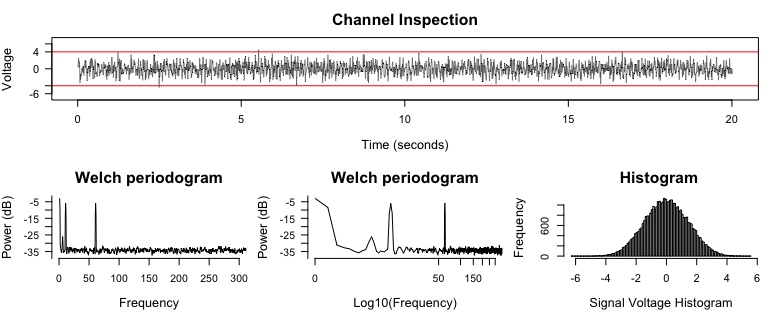
notch_filter removes the electrical line frequency and its harmonics.
Passing two signals to diagnose_channel compares them side by side:
## ------- Notch filter --------
signal2 <- notch_filter(signal, sample_rate = 2000)

diagnose_channel(signal, signal2, srate = 2000,
                 name = c("Raw", "Filtered"))
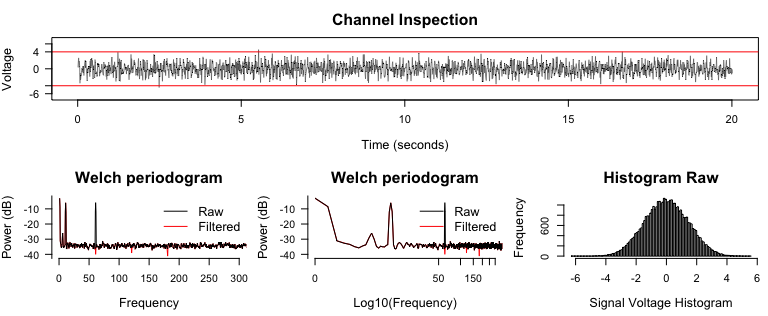
There are two ways to obtain a time-frequency decomposition.
morlet_wavelet uses the
Morlet wavelet and
returns both amplitude and phase; multitaper returns no phase, but its
amplitude is smoother.
Using morlet_wavelet:
## ---------- Wavelet -----------
coef <- morlet_wavelet(
  signal2, freqs = seq(1, 100, by = 1),
  srate = 2000, wave_num = c(2, 15))
amplitude <- 20 * log10(Mod(coef[]))

# For each frequency, decimate to 100 Hz
downsample_amp <- apply(amplitude, 2, decimate, q = 20)
downsample_time <- decimate(time, q = 20)

par(mfrow = c(1,1))
image(
  z = downsample_amp,
  x = downsample_time,
  y = seq(1, 100, by = 1),
  xlab = "Time (s)",
  ylab = "Frequency (Hz)",
  main = "Amplitude (dB)",
  sub = "Wavelet at 2000 Hz, then down-sampled to 100 Hz",
  col = matlab_palette()
)
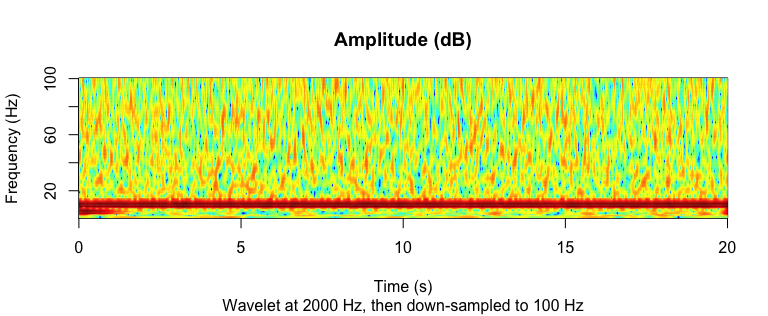
For very long recordings, morlet_wavelet(segment_length = ...)
processes the signal in overlapping segments, cutting peak memory and
FFT cost without changing the result on the signal interior.
Using multitaper. The algorithm is modified from source code
here; please credit
them as well if you adopt this approach.
## ---------- Multitaper -----------
res <- multitaper(
  data = signal2,
  fs = 2000,
  frequency_range = c(1, 100),
  time_bandwidth = 5,
  window_params = c(2, 0.05)
)

par(mfrow = c(1,1))
image(
  x = res$time,
  y = res$frequency,
  z = 10 * log10(res$spec),
  xlab = "Time (s)",
  ylab = 'Frequency (Hz)',
  col = matlab_palette(),
  main = "Amplitude (dB)"
)

Also in this group: pwelch and mv_pwelch for power spectral density,
plot_signals for drawing many traces on one canvas, baseline_array
for baseline correction across array margins (seven methods, including
decibel and z-score), plus decimate, detrend, find_peaks,
gammatone_fast, wavelet_kernels, and wavelet_cycles_suggest.
1.2 Brain stimulation tools
Single-pulse electrical stimulation produces cortico-cortical evoked
potentials (CCEPs). ravetools implements three published methods for
analyzing them. Each is a faithful re-implementation, so please cite the
original work if you use it.
carla selects the subset of channels that makes the cleanest
common average reference, by choosing the subset size with the least
anti-correlation against the remaining channels. From Huang and
colleagues (2024),
doi:10.1016/j.jneumeth.2024.110153;
the virtual_reference = TRUE variant follows Huang and colleagues
(2025),
doi:10.1016/j.jneumeth.2025.110461.
crp parameterizes single-trial evoked responses: it estimates the
response duration, extracts the canonical response shape, and reports
per-trial weights, signal-to-noise, and explained variance. From Miller
and colleagues (2023),
doi:10.1371/journal.pcbi.1011105.
bpc identifies a small set of basis profile curves shared across
stimulation sites, then assigns each site to the curve that best
explains its trials. From Miller and colleagues (2021),
doi:10.1371/journal.pcbi.1008710.
A basic run through the first two:
set.seed(42)

# A toy CCEP epoch: 16 channels x 30 trials, only channels 1-4 respond
sample_rate <- 1000
time <- seq(-0.1, 0.4 - 1 / sample_rate, by = 1 / sample_rate)
nchan <- 16
ntrial <- 30
evoked <- ifelse(time >= 0, 80 * exp(-time / 0.05) * sin(2 * pi * 12 * time), 0)

x <- array(rnorm(length(time) * ntrial * nchan, sd = 5),
           dim = c(length(time), ntrial, nchan))
for (ch in 1:4) {
  for (k in seq_len(ntrial)) {
    x[, k, ch] <- x[, k, ch] + evoked * runif(1, 0.6, 1.4)
  }
}

# 1. Which channels make the cleanest common average reference?
#    `x` is time x trials x channels, cropped to the responsive window.
fit <- carla(x[time > 0 & time <= 0.3, , , drop = FALSE])
fit$n_optimum   #> 12
fit$channels    #> 5 6 7 8 9 10 11 12 13 14 15 16   (channels 1-4 excluded)

# 2. Re-reference against that subset
reference <- apply(x[, , fit$channels, drop = FALSE], c(1, 2), mean)
x_ref <- sweep(x, c(1, 2), reference, "-")

# 3. Parameterize the evoked response on a responsive channel
res <- crp(x_ref[, , 1], time = time, t_start = 0.015, t_end = 0.3)
res$tau_R       #> 0.119   (response duration, in seconds)

plot(res)

carla also accepts a filearray in place of an in-memory array, so
large datasets can stay on disk.
For continuous stimulation rather than single pulses, stimpulse_find,
stimpulse_align, stimpulse_extract, and stimpulse_interpolate
locate the pulse train, align the pulses, and interpolate the artifact
away. The bundled stimulation_signal dataset is a one-second recording
at 30 kHz to try them on.
1.3 Low-level filters and designs
Most filtering work starts from a specification - a pass band of 8 to 12
Hz, fully attenuated beyond 6 and 14 Hz - rather than from a filter
order. design_filter takes that specification and, given data,
designs and applies the filter in a single call:
filtered <- design_filter(
  data = signal, sample_rate = 2000,
  high_pass_freq = 8, low_pass_freq = 12
)
design_filter_fir and design_filter_iir return the filter itself, so
it can be inspected before being committed to. diagnose_filter draws
the pass band, the stop band, the phase response, and the effect on a
sample signal in one figure:
set.seed(1)
sample_rate <- 200
time <- seq(0, 10, by = 1 / sample_rate)

# A mixture of 2 Hz, 10 Hz, and 60 Hz
x <- sin(time * 4 * pi) + sin(time * 20 * pi) +
  2 * sin(time * 120 * pi) + rnorm(length(time), sd = 0.4)

# Design an alpha-band filter from the specification rather than from an order
filter <- design_filter_fir(
  sample_rate = sample_rate,
  high_pass_freq = 8, high_pass_trans_freq = 2,
  low_pass_freq = 12, low_pass_trans_freq = 2
)
filter          #> <FIR filter>   Method: kaiser   Order: 223

# Inspect the filter against the signal it will be applied to
diagnose_filter(filter$b, filter$a, fs = sample_rate, sample = x)

IIR filters can be numerically unstable at high orders, so
design_filter checks the order it derives against rcond_filter_ar,
the reciprocal condition number of the autoregressive coefficients, and
check_filter reports the achieved magnitude at any frequency. The
filter printed above carries both.
Also in this group: filter_signal and filtfilt for applying filters
(filtfilt accepts a gsignal second-order-section object), freqz2
for the frequency response, band_pass1 and band_pass2, the fir1
and firls designers, and the window functions hamming, hanning,
blackman, blackmanharris, blackmannuttall, bohmanwin, and
flattopwin.
The classical analog prototype designers - butter, cheby1, cheby2,
ellip, and their order-selection companions - are re-exported from
gsignal for convenience. They belong to that package, not to this one.
2. Image processing
2.1 3D volume processing and visualization
register_volume3d aligns two 3D volumes: CT to MRI, MRI to
MRI, or a subject to a template. It is implemented from scratch in
RcppEigen and mirrors the behavior of ANTs antsRegistration - a
multi-resolution, physical-shift-scaled gradient-descent optimizer
driving a similarity metric, working entirely in anatomical RAS space.
It depends on no external registration library.
Each volume carries its own vox2ras matrix, so volumes differing in
sampling, orientation, or field of view are handled correctly. The
transform can be rigid (6 degrees of freedom), affine (12), or syn
(an affine followed by a symmetric diffeomorphic deformation).
The example below is self-contained: it displaces a known volume by a
known transform, then recovers it.
data("left_hippocampus_mask")

# Blur the binary mask into a smooth intensity volume, and place it in RAS
gauss3 <- function(n = 5, sigma = 1.2) {
  g <- exp(-(seq(-(n - 1) / 2, (n - 1) / 2)^2) / (2 * sigma^2))
  array(outer(outer(g, g), g), dim = c(n, n, n)) / sum(g)^3
}
target <- convolve_volume(left_hippocampus_mask, gauss3())
vox2ras <- diag(4)
vox2ras[1:3, 4] <- -dim(target) / 2

# A known displacement: 8 degrees about the z axis, plus a translation
theta <- 8 * pi / 180
known <- diag(4)
known[1:2, 1:2] <- c(cos(theta), sin(theta), -sin(theta), cos(theta))
known[1:3, 4] <- c(2.5, -3, 1.5)

# Resample the target through the inverse to obtain a misaligned source
source <- apply_transform3d(target, vox2ras, solve(known))

# Recover the displacement
aligned <- register_volume3d(
  source, target,
  source_vox2ras = vox2ras, target_vox2ras = vox2ras,
  type = "syn", metric = "cc", verbose = FALSE
)
round(aligned$transform[1:3, 4], 2)   #> 2.51 -3.04 1.49   (known: 2.5 -3 1.5)

slice <- 22
zlim <- range(target)
pal <- grDevices::grey.colors(256, start = 0, end = 1)
oldpar <- par(mfrow = c(1, 4), mar = c(0.5, 0.5, 2.5, 0.5))
image(target[, , slice], asp = 1, axes = FALSE, col = pal, zlim = zlim,
      main = "Target (fixed)")
image(source[, , slice], asp = 1, axes = FALSE, col = pal, zlim = zlim,
      main = "Source (moving)")
image(aligned$image[, , slice], asp = 1, axes = FALSE, col = pal, zlim = zlim,
      main = "Aligned")
image(abs(aligned$image - target)[, , slice], asp = 1, axes = FALSE, col = pal,
      zlim = zlim, main = "Absolute difference")
par(oldpar)

The result carries the 4x4 RAS-to-RAS transform, the warped
image, and, for syn, the forward_field and inverse_field
deformations. apply_transform3d replays any of them onto a new volume.
register_volume3d accepts more than one modality: pass a list of
co-registered volumes with per-channel weights and metric to let a
T1, a T2, and an atlas jointly drive the deformable stage. Masks
(source_mask, target_mask) restrict where the metric is evaluated,
and corresponding landmarks (source_points, target_points) add a
surface term that recovers the cortical folding an intensity metric
would otherwise blur over.
Results are compatible with ANTs: write_ants_transform writes the
linear part as an ITK affine .mat file and write_ants_warp
writes the deformation as an ANTs 5-D warp NIfTI, both readable by
antsApplyTransforms. save_registration and load_registration
round-trip an entire result. No HDF5 is involved anywhere along this
path.
A note on history: register_volume predates all of the above and wraps
NiftyReg (Modat and colleagues, 2014). It still works and is kept
for existing code, but register_volume3d is the recommended path going
forward.
Also in this group: resample_3d_volume for re-sampling onto a new
grid, convolve_volume and convolve_image for FFT-based 2D and 3D
convolution, grow_volume for dilating a mask, and fill_surface for
filling a volume from a surface envelope.
2.2 Surface processing and visualization
A volume becomes a surface through vcg_isosurface or
mesh_from_volume. From there the mesh can be repaired, smoothed,
re-meshed, inflated, and measured. Every mesh object returned by
ravetools carries the ravetools_mesh3d class, so plot() renders it
directly - in base R graphics, with no rgl dependency.
data("left_hippocampus_mask")

# Volume -> mesh, repaired and smoothed
mesh <- vcg_isosurface(left_hippocampus_mask)
mesh <- vcg_fix_defects(mesh, verbose = FALSE)
mesh <- mris_smooth(mesh, niterations = 20L)
mesh$vb[1:3, ] <- mesh$vb[1:3, ] - rowMeans(mesh$vb[1:3, ])

# Per-vertex curvature, mapped onto a diverging color ramp centered at zero
curv <- mris_curvature(mesh)
lim <- stats::quantile(abs(curv$mean), 0.95)
col <- color_ramp_continuous(
  curv$mean, clim = c(-lim, lim),
  cmap = c("#2c5f8a", "#f2f2f2", "#a33a3a")
)

# Inflate the surface while preserving total surface area
inflated <- mris_inflate(mesh, n_averages = 4L, niterations = 8L,
                         scale_brain = FALSE, verbose = FALSE)

oldpar <- par(mfrow = c(1, 2), mar = c(0.1, 0.1, 2.1, 0.1))
plot(mesh, col = col, eye = c(0, 100, 30), up = c(0, 0, 1),
     main = "Mean curvature")
plot(inflated$mesh, col = col, eye = c(0, 100, 30), up = c(0, 0, 1),
     main = "The same, inflated")
par(oldpar)

plot_mesh_polygon draws flat-shaded Lambert-lit triangles and
plot_mesh_dotcloud draws an orthographic rim-lit dot cloud. Both
support per-vertex colors, per-mesh alpha, camera-facing clipping, and
arbitrary clipping planes; plot() dispatches to whichever suits the
mesh. If rgl is available, rgl_view, rgl_call, and
rgl_plot_normals drive it instead.
Two further surface operations are worth naming:
dijkstras_surface_distance and surface_path find geodesic shortest
paths across a mesh, and vcg_detect_collision reports exact collisions
and proximity within a tolerance between any two of a point cloud, a
chain of connected line segments (diffusion streamlines, for instance),
and a triangular mesh.
ensure_mesh3d coerces the common surface formats - mesh3d,
ieegio_surface, fs.surface, and surf.asc - into a canonical mesh,
so surfaces from FreeSurfer and friends drop straight into any of the
above.
2.3 High-performance low-level geometry
The vcg_* and mris_* families are the building blocks the two
sections above are assembled from. They are usable directly:
| Group | Functions |
|:---|:---|
| Construct | vcg_isosurface, vcg_sphere, plane_geometry, mesh_from_volume |
| Repair and re-mesh | vcg_fix_defects, vcg_count_edge_defects, vcg_uniform_remesh, vcg_subdivision, vcg_subdivide_max_edge_length, mris_remesh |
| Smooth and deform | vcg_smooth_explicit, vcg_smooth_implicit, mris_smooth, mris_inflate, mris_sphere |
| Measure | vcg_mesh_volume, vcg_average_edge_length, vcg_max_edge_length, mris_curvature |
| Query | vcg_kdtree_nearest, vcg_raycaster, vcg_detect_collision |
| Subset and extract | vcg_subset_vertex, vcg_mesh_patch, mris_make_surfaces |
They compose. Two primitives, the three Query functions asked about
them, and one plot call:
# A unit sphere, and a plane tilted so that it slices through it
sphere <- vcg_sphere(sub_division = 4)
plane <- plane_geometry(width = 2.6, height = 2.6, shape = c(40, 40))
tilt <- new_matrix4()$make_rotation_y(25 * pi / 180)$to_array()
plane$vb <- (tilt %*% rbind(plane$vb[1:3, ], 1))[1:3, ] + c(0, 0, 0.35)

# Which of the 3042 plane triangles actually cut the sphere?
cut <- vcg_detect_collision(sphere, plane, radius = 0.02)
band <- plane
band$it <- plane$it[, which(cut$hit_unit), drop = FALSE]

# Nearest sphere vertex to every plane vertex, mapped onto a color ramp
kd <- vcg_kdtree_nearest(target = sphere, query = plane, k = 1)
col <- color_ramp_continuous(kd$distance[, 1],
                             cmap = c("#f2f2f2", "#7fa8c9", "#2c5f8a"))

# Lift the same plane clear of the sphere, then drop a ray from every vertex
above <- plane$vb
above[3, ] <- above[3, ] + 1.8
rays <- vcg_raycaster(sphere, ray_origin = above, ray_direction = c(0, 0, -1))
pierce <- structure(
  list(vb = rays$intersection[, rays$has_intersection, drop = FALSE]),
  class = "mesh3d"
)

oldpar <- par(mfrow = c(1, 2), mar = c(0.1, 0.1, 2.1, 0.1))
plot_mesh_polygon(
  list(sphere, plane, band),
  col = list("gray55", col, "#a33a3a"), alpha = c(0.5, 0.92, 1),
  eye = c(3.5, -4, 2.2), up = c(0, 0, 1), zoom = 1.15,
  shadow_color = "white", ambient_intensity = 0.55,
  main = "Distance to the sphere; cut faces in red"
)
plot_mesh_polygon(
  list(sphere, pierce),
  col = list("gray72", "#a33a3a"), cex = 0.03,
  eye = c(3.5, -4, 2.2), up = c(0, 0, 1), zoom = 0.68,
  shadow_color = "white", ambient_intensity = 0.55,
  main = "Where a downward ray enters the sphere"
)
par(oldpar)

307 of the plane’s triangles cut the sphere, and 780 of the 1600 dropped
rays land on it. The two distances answer different questions:
vcg_detect_collision reports the exact minimum distance to the
surface, while vcg_kdtree_nearest reports the distance to the nearest
vertex - the sampled approximation that is cheaper and usually good
enough. A point cloud handed to plot_mesh_polygon with no face matrix
is drawn as one small sphere per point, which is how the ray hits are
rendered above.
The vignette("mesh-geometry", package = "ravetools") article walks the
rest of the table - repair, re-meshing, smoothing, inflation, patches,
and geodesic paths - on a real hippocampus surface.
The vcg_* functions are built on
vcglib from the Visual
Computing Lab, ISTI. mris_remesh implements the isotropic re-meshing
algorithm of Botsch and Kobbelt (2003), and the mris_inflate and
mris_sphere pair follows the cortical inflation and spherical mapping
of Fischl and colleagues (1999).
3. Utilities and helpers
Below the two domains sit the primitives everything else is built from.
They are exported because they are useful on their own.
| Group | Functions |
|:---|:---|
| FFTW3 | fftw_r2c, fftw_c2r, fftw_c2c and their 2D/3D variants; the batched mvfftw_r2c, mvfftw_c2r, mvfftw_c2c; convolve_signal, convolve_image, convolve_volume |
| Parallel array operations | collapse, shift_array, baseline_array, fast_cov, fast_median, fast_quantile, fast_mvmedian, fast_mvquantile |
| Threading | ravetools_threads, detect_threads |
| Geometry and math | new_vector3, new_matrix4, new_quaternion (in-place classes), apply_transform3d, catmull_rom_3d, project_plane, naive_nmf |
| Binary and color | raw_to_int8 through raw_to_int64, raw_to_float, raw_to_string, matlab_palette, color_ramp_continuous |
The heavy loops are C++ parallelized with TinyThread.
detect_threads reports how many threads are available and
ravetools_threads sets how many are used:
detect_threads()
ravetools_threads(n_threads = 4)
Where a computation would not fit in memory, the entry points accept
on-disk filearray inputs instead - carla is one - and
morlet_wavelet(segment_length = ...) streams long recordings segment
by segment.
The fftw_* wrappers are thin bindings over FFTW3 for callers who
need maximum throughput and are willing to manage the layout themselves.
The C++ headers are exposed in inst/include, so other packages can
link against them directly.
Citation
ravetools is part of RAVE. To cite it in publications, please cite
the RAVE paper from Beauchamp's lab:
Magnotti, JF, and Wang, Z, and Beauchamp, MS. RAVE: comprehensive
  open-source software for reproducible analysis and visualization of
  intracranial EEG data. NeuroImage, 223, p.117341.
Several functions re-implement published methods. If you use one of
them, please cite the original work as well; citation("ravetools")
lists them all.
References
[1] Magnotti, JF, and Wang, Z, and Beauchamp, MS (2020). RAVE: comprehensive
    open-source software for reproducible analysis and visualization of
    intracranial EEG data. NeuroImage, 223, p.117341.
[2] Prerau, MJ, and Brown, RE, and Bianchi, MT, and Ellenbogen, JM, and
    Purdon, PL (2016). Sleep Neurophysiological Dynamics Through the Lens of
    Multitaper Spectral Analysis. Physiology, December 7, 2016, 60-92.
[3] Avants, BB, and Epstein, CL, and Grossman, M, and Gee, JC (2008).
    Symmetric diffeomorphic image registration with cross-correlation:
    evaluating automated labeling of elderly and neurodegenerative brain.
    Medical Image Analysis, 12(1), 26-41.
[4] Fischl, B, and Sereno, MI, and Dale, AM (1999). Cortical surface-based
    analysis II: inflation, flattening, and a surface-based coordinate
    system. NeuroImage, 9(2), 195-207.
[5] Huang, H, and Ojeda Valencia, G, and Gregg, NM, and Osman, GM, and
    Montoya, MN, and Worrell, GA, and Miller, KJ, and Hermes, D (2024).
    CARLA: Adjusted common average referencing for cortico-cortical evoked
    potential data. Journal of Neuroscience Methods, 407, 110153.
[6] Huang, H, and Adkinson, JA, and Jensen, MA, and Hasen, M, and Danstrom,
    IA, and Bijanki, KR, and Gregg, NM, and Miller, KJ, and Sheth, SA, and
    Hermes, D, and Bartoli, E (2025). Proper reference selection and
    re-referencing to mitigate bias in single pulse electrical stimulation
    data. Journal of Neuroscience Methods, 419, 110461.
[7] Miller, KJ, and Mueller, K-R, and Ojeda Valencia, G, and Huang, H, and
    Gregg, NM, and Worrell, GA, and Hermes, D (2023). Canonical response
    parameterization: Quantifying the structure of responses to single-pulse
    intracranial electrical brain stimulation. PLOS Computational Biology,
    19(5), e1011105.
[8] Miller, KJ, and Mueller, K-R, and Hermes, D (2021). Basis profile curve
    identification to understand electrical stimulation effects in human
    brain networks. PLOS Computational Biology, 17(9), e1008710.
[9] Botsch, M, and Kobbelt, L (2003). A remeshing approach to multiresolution
    modeling. Proceedings of Shape Modelling International, 49-58.
[10] Modat, M, and Cash, DM, and Daga, P, and Winston, GP, and Duncan, JS,
    and Ourselin, S (2014). Global image registration using a symmetric
    block-matching approach. Journal of Medical Imaging, 1(2), 024003.
[11] Allaire, JJ, and Francois, R, and Ushey, K, and Vandenbrouck, G, and
    Geelnard, M, and Intel (2022). RcppParallel: Parallel Programming Tools
    for 'Rcpp'. R package version 5.1.5.
    https://CRAN.R-project.org/package=RcppParallel
Attributions
The multitaper function (MIT license) derives from a script by
Prerau's lab. The TinyParallel code derives from the RcppParallel
package (GPL license) with the TBB features removed, using only
tinythreads. The vcg_* functions build on vcglib, copyright the
Visual Computing Lab, ISTI, with the R interface layer derived from
work by Stefan Schlager. register_volume wraps NiftyReg, developed
by CMIC at University College London.
Try the ravetools package in your browser
Any scripts or data that you put into this service are public.
ravetools documentation built on Aug. 31, 2026, 5:07 p.m.
R Package Documentation
Browse R Packages
We want your feedback!
Note that we can't provide technical support on individual packages. You should contact the package authors for that.
ravetools
ravetools is the signal- and image-processing toolbox behind RAVE, a
software suite for analyzing intracranial Electroencephalography
(iEEG) data.
It is deliberately a mathematical toolbox rather than an analysis
pipeline. It supplies the fast, memory-efficient primitives - filters,
spectral decomposition, image registration, surface geometry - and
leaves the user-facing pipelines to the other RAVE packages built on
top of it. Every routine is a plain function operating on plain R
objects.
Highlights:
- Memory-efficient
Notchfilter,Welchperiodogram, andMorletwavelet that scale to hours of high-resolution recording - Single-pulse electrical stimulation analysis:
CARLAre-referencing, canonical response parameterization, and basis profile curves FIRandIIRfilter design driven by a specification instead of a filter order, with stability diagnostics- Self-contained 3D image registration (
rigid,affine, andSyN) that depends on no external registration library - Surface reconstruction, re-meshing, inflation, curvature, and collision detection
- 3D mesh rendering in base R, with no
rgldependency - Parallel
C++array primitives and direct access toFFTW3
What is inside
| Part | Contents |
|:---|:---|
| 1. Signal processing | Channel diagnosis and time-frequency decomposition; brain stimulation tools; filter design |
| 2. Image processing | 3D volume registration and resampling; surface reconstruction and rendering; low-level geometry |
| 3. Utilities and helpers | FFTW3 bindings, parallel array operations, geometry classes, binary readers |
The complete function reference lives at
dipterix.org/ravetools.
Installation
The package is on CRAN. To install the compiled version, simply run:
install.packages("ravetools")
Development builds are on r-universe:
install.packages("ravetools", repos = "https://dipterix.r-universe.dev")
Installing from source needs a C++ compiler, the
FFTW3 library, and pkg-config - nothing
else. See this
document
for platform-by-platform instructions.
1. Signal processing
1.1 Data analysis and diagnosis
The starting point for a channel is usually to look at it, clean the line noise, and decompose it in time and frequency.
Generate a toy channel and inspect it. diagnose_channel combines the
trace, the Welch periodogram, and the histogram into one figure:
library(ravetools)
set.seed(2023)
# Generate 20 second data at 2000 Hz
time <- seq(0, 20, by = 1 / 2000)
signal <- sin( 120 * pi * time) +
sin(time * 20*pi) +
exp(-time^2) *
cos(time * 10*pi) +
rnorm(length(time))
diagnose_channel(signal, srate = 2000)
notch_filter removes the electrical line frequency and its harmonics.
Passing two signals to diagnose_channel compares them side by side:
## ------- Notch filter --------
signal2 <- notch_filter(signal, sample_rate = 2000)
diagnose_channel(signal, signal2, srate = 2000,
name = c("Raw", "Filtered"))
There are two ways to obtain a time-frequency decomposition.
morlet_wavelet uses the
Morlet wavelet and
returns both amplitude and phase; multitaper returns no phase, but its
amplitude is smoother.
Using morlet_wavelet:
## ---------- Wavelet -----------
coef <- morlet_wavelet(
signal2, freqs = seq(1, 100, by = 1),
srate = 2000, wave_num = c(2, 15))
amplitude <- 20 * log10(Mod(coef[]))
# For each frequency, decimate to 100 Hz
downsample_amp <- apply(amplitude, 2, decimate, q = 20)
downsample_time <- decimate(time, q = 20)
par(mfrow = c(1,1))
image(
z = downsample_amp,
x = downsample_time,
y = seq(1, 100, by = 1),
xlab = "Time (s)",
ylab = "Frequency (Hz)",
main = "Amplitude (dB)",
sub = "Wavelet at 2000 Hz, then down-sampled to 100 Hz",
col = matlab_palette()
)
For very long recordings, morlet_wavelet(segment_length = ...)
processes the signal in overlapping segments, cutting peak memory and
FFT cost without changing the result on the signal interior.
Using multitaper. The algorithm is modified from source code
here; please credit
them as well if you adopt this approach.
## ---------- Multitaper -----------
res <- multitaper(
data = signal2,
fs = 2000,
frequency_range = c(1, 100),
time_bandwidth = 5,
window_params = c(2, 0.05)
)
par(mfrow = c(1,1))
image(
x = res$time,
y = res$frequency,
z = 10 * log10(res$spec),
xlab = "Time (s)",
ylab = 'Frequency (Hz)',
col = matlab_palette(),
main = "Amplitude (dB)"
)
Also in this group: pwelch and mv_pwelch for power spectral density,
plot_signals for drawing many traces on one canvas, baseline_array
for baseline correction across array margins (seven methods, including
decibel and z-score), plus decimate, detrend, find_peaks,
gammatone_fast, wavelet_kernels, and wavelet_cycles_suggest.
1.2 Brain stimulation tools
Single-pulse electrical stimulation produces cortico-cortical evoked
potentials (CCEPs). ravetools implements three published methods for
analyzing them. Each is a faithful re-implementation, so please cite the
original work if you use it.
carla selects the subset of channels that makes the cleanest
common average reference, by choosing the subset size with the least
anti-correlation against the remaining channels. From Huang and
colleagues (2024),
doi:10.1016/j.jneumeth.2024.110153;
the virtual_reference = TRUE variant follows Huang and colleagues
(2025),
doi:10.1016/j.jneumeth.2025.110461.
crp parameterizes single-trial evoked responses: it estimates the
response duration, extracts the canonical response shape, and reports
per-trial weights, signal-to-noise, and explained variance. From Miller
and colleagues (2023),
doi:10.1371/journal.pcbi.1011105.
bpc identifies a small set of basis profile curves shared across
stimulation sites, then assigns each site to the curve that best
explains its trials. From Miller and colleagues (2021),
doi:10.1371/journal.pcbi.1008710.
A basic run through the first two:
set.seed(42)
# A toy CCEP epoch: 16 channels x 30 trials, only channels 1-4 respond
sample_rate <- 1000
time <- seq(-0.1, 0.4 - 1 / sample_rate, by = 1 / sample_rate)
nchan <- 16
ntrial <- 30
evoked <- ifelse(time >= 0, 80 * exp(-time / 0.05) * sin(2 * pi * 12 * time), 0)
x <- array(rnorm(length(time) * ntrial * nchan, sd = 5),
dim = c(length(time), ntrial, nchan))
for (ch in 1:4) {
for (k in seq_len(ntrial)) {
x[, k, ch] <- x[, k, ch] + evoked * runif(1, 0.6, 1.4)
}
}
# 1. Which channels make the cleanest common average reference?
# `x` is time x trials x channels, cropped to the responsive window.
fit <- carla(x[time > 0 & time <= 0.3, , , drop = FALSE])
fit$n_optimum #> 12
fit$channels #> 5 6 7 8 9 10 11 12 13 14 15 16 (channels 1-4 excluded)
# 2. Re-reference against that subset
reference <- apply(x[, , fit$channels, drop = FALSE], c(1, 2), mean)
x_ref <- sweep(x, c(1, 2), reference, "-")
# 3. Parameterize the evoked response on a responsive channel
res <- crp(x_ref[, , 1], time = time, t_start = 0.015, t_end = 0.3)
res$tau_R #> 0.119 (response duration, in seconds)
plot(res)
carla also accepts a filearray in place of an in-memory array, so
large datasets can stay on disk.
For continuous stimulation rather than single pulses, stimpulse_find,
stimpulse_align, stimpulse_extract, and stimpulse_interpolate
locate the pulse train, align the pulses, and interpolate the artifact
away. The bundled stimulation_signal dataset is a one-second recording
at 30 kHz to try them on.
1.3 Low-level filters and designs
Most filtering work starts from a specification - a pass band of 8 to 12
Hz, fully attenuated beyond 6 and 14 Hz - rather than from a filter
order. design_filter takes that specification and, given data,
designs and applies the filter in a single call:
filtered <- design_filter(
data = signal, sample_rate = 2000,
high_pass_freq = 8, low_pass_freq = 12
)
design_filter_fir and design_filter_iir return the filter itself, so
it can be inspected before being committed to. diagnose_filter draws
the pass band, the stop band, the phase response, and the effect on a
sample signal in one figure:
set.seed(1)
sample_rate <- 200
time <- seq(0, 10, by = 1 / sample_rate)
# A mixture of 2 Hz, 10 Hz, and 60 Hz
x <- sin(time * 4 * pi) + sin(time * 20 * pi) +
2 * sin(time * 120 * pi) + rnorm(length(time), sd = 0.4)
# Design an alpha-band filter from the specification rather than from an order
filter <- design_filter_fir(
sample_rate = sample_rate,
high_pass_freq = 8, high_pass_trans_freq = 2,
low_pass_freq = 12, low_pass_trans_freq = 2
)
filter #> <FIR filter> Method: kaiser Order: 223
# Inspect the filter against the signal it will be applied to
diagnose_filter(filter$b, filter$a, fs = sample_rate, sample = x)
IIR filters can be numerically unstable at high orders, so
design_filter checks the order it derives against rcond_filter_ar,
the reciprocal condition number of the autoregressive coefficients, and
check_filter reports the achieved magnitude at any frequency. The
filter printed above carries both.
Also in this group: filter_signal and filtfilt for applying filters
(filtfilt accepts a gsignal second-order-section object), freqz2
for the frequency response, band_pass1 and band_pass2, the fir1
and firls designers, and the window functions hamming, hanning,
blackman, blackmanharris, blackmannuttall, bohmanwin, and
flattopwin.
The classical analog prototype designers - butter, cheby1, cheby2,
ellip, and their order-selection companions - are re-exported from
gsignal for convenience. They belong to that package, not to this one.
2. Image processing
2.1 3D volume processing and visualization
register_volume3d aligns two 3D volumes: CT to MRI, MRI to
MRI, or a subject to a template. It is implemented from scratch in
RcppEigen and mirrors the behavior of ANTs antsRegistration - a
multi-resolution, physical-shift-scaled gradient-descent optimizer
driving a similarity metric, working entirely in anatomical RAS space.
It depends on no external registration library.
Each volume carries its own vox2ras matrix, so volumes differing in
sampling, orientation, or field of view are handled correctly. The
transform can be rigid (6 degrees of freedom), affine (12), or syn
(an affine followed by a symmetric diffeomorphic deformation).
The example below is self-contained: it displaces a known volume by a known transform, then recovers it.
data("left_hippocampus_mask")
# Blur the binary mask into a smooth intensity volume, and place it in RAS
gauss3 <- function(n = 5, sigma = 1.2) {
g <- exp(-(seq(-(n - 1) / 2, (n - 1) / 2)^2) / (2 * sigma^2))
array(outer(outer(g, g), g), dim = c(n, n, n)) / sum(g)^3
}
target <- convolve_volume(left_hippocampus_mask, gauss3())
vox2ras <- diag(4)
vox2ras[1:3, 4] <- -dim(target) / 2
# A known displacement: 8 degrees about the z axis, plus a translation
theta <- 8 * pi / 180
known <- diag(4)
known[1:2, 1:2] <- c(cos(theta), sin(theta), -sin(theta), cos(theta))
known[1:3, 4] <- c(2.5, -3, 1.5)
# Resample the target through the inverse to obtain a misaligned source
source <- apply_transform3d(target, vox2ras, solve(known))
# Recover the displacement
aligned <- register_volume3d(
source, target,
source_vox2ras = vox2ras, target_vox2ras = vox2ras,
type = "syn", metric = "cc", verbose = FALSE
)
round(aligned$transform[1:3, 4], 2) #> 2.51 -3.04 1.49 (known: 2.5 -3 1.5)
slice <- 22
zlim <- range(target)
pal <- grDevices::grey.colors(256, start = 0, end = 1)
oldpar <- par(mfrow = c(1, 4), mar = c(0.5, 0.5, 2.5, 0.5))
image(target[, , slice], asp = 1, axes = FALSE, col = pal, zlim = zlim,
main = "Target (fixed)")
image(source[, , slice], asp = 1, axes = FALSE, col = pal, zlim = zlim,
main = "Source (moving)")
image(aligned$image[, , slice], asp = 1, axes = FALSE, col = pal, zlim = zlim,
main = "Aligned")
image(abs(aligned$image - target)[, , slice], asp = 1, axes = FALSE, col = pal,
zlim = zlim, main = "Absolute difference")
par(oldpar)
The result carries the 4x4 RAS-to-RAS transform, the warped
image, and, for syn, the forward_field and inverse_field
deformations. apply_transform3d replays any of them onto a new volume.
register_volume3d accepts more than one modality: pass a list of
co-registered volumes with per-channel weights and metric to let a
T1, a T2, and an atlas jointly drive the deformable stage. Masks
(source_mask, target_mask) restrict where the metric is evaluated,
and corresponding landmarks (source_points, target_points) add a
surface term that recovers the cortical folding an intensity metric
would otherwise blur over.
Results are compatible with ANTs: write_ants_transform writes the
linear part as an ITK affine .mat file and write_ants_warp
writes the deformation as an ANTs 5-D warp NIfTI, both readable by
antsApplyTransforms. save_registration and load_registration
round-trip an entire result. No HDF5 is involved anywhere along this
path.
A note on history: register_volume predates all of the above and wraps
NiftyReg (Modat and colleagues, 2014). It still works and is kept
for existing code, but register_volume3d is the recommended path going
forward.
Also in this group: resample_3d_volume for re-sampling onto a new
grid, convolve_volume and convolve_image for FFT-based 2D and 3D
convolution, grow_volume for dilating a mask, and fill_surface for
filling a volume from a surface envelope.
2.2 Surface processing and visualization
A volume becomes a surface through vcg_isosurface or
mesh_from_volume. From there the mesh can be repaired, smoothed,
re-meshed, inflated, and measured. Every mesh object returned by
ravetools carries the ravetools_mesh3d class, so plot() renders it
directly - in base R graphics, with no rgl dependency.
data("left_hippocampus_mask")
# Volume -> mesh, repaired and smoothed
mesh <- vcg_isosurface(left_hippocampus_mask)
mesh <- vcg_fix_defects(mesh, verbose = FALSE)
mesh <- mris_smooth(mesh, niterations = 20L)
mesh$vb[1:3, ] <- mesh$vb[1:3, ] - rowMeans(mesh$vb[1:3, ])
# Per-vertex curvature, mapped onto a diverging color ramp centered at zero
curv <- mris_curvature(mesh)
lim <- stats::quantile(abs(curv$mean), 0.95)
col <- color_ramp_continuous(
curv$mean, clim = c(-lim, lim),
cmap = c("#2c5f8a", "#f2f2f2", "#a33a3a")
)
# Inflate the surface while preserving total surface area
inflated <- mris_inflate(mesh, n_averages = 4L, niterations = 8L,
scale_brain = FALSE, verbose = FALSE)
oldpar <- par(mfrow = c(1, 2), mar = c(0.1, 0.1, 2.1, 0.1))
plot(mesh, col = col, eye = c(0, 100, 30), up = c(0, 0, 1),
main = "Mean curvature")
plot(inflated$mesh, col = col, eye = c(0, 100, 30), up = c(0, 0, 1),
main = "The same, inflated")
par(oldpar)
plot_mesh_polygon draws flat-shaded Lambert-lit triangles and
plot_mesh_dotcloud draws an orthographic rim-lit dot cloud. Both
support per-vertex colors, per-mesh alpha, camera-facing clipping, and
arbitrary clipping planes; plot() dispatches to whichever suits the
mesh. If rgl is available, rgl_view, rgl_call, and
rgl_plot_normals drive it instead.
Two further surface operations are worth naming:
dijkstras_surface_distance and surface_path find geodesic shortest
paths across a mesh, and vcg_detect_collision reports exact collisions
and proximity within a tolerance between any two of a point cloud, a
chain of connected line segments (diffusion streamlines, for instance),
and a triangular mesh.
ensure_mesh3d coerces the common surface formats - mesh3d,
ieegio_surface, fs.surface, and surf.asc - into a canonical mesh,
so surfaces from FreeSurfer and friends drop straight into any of the
above.
2.3 High-performance low-level geometry
The vcg_* and mris_* families are the building blocks the two
sections above are assembled from. They are usable directly:
| Group | Functions |
|:---|:---|
| Construct | vcg_isosurface, vcg_sphere, plane_geometry, mesh_from_volume |
| Repair and re-mesh | vcg_fix_defects, vcg_count_edge_defects, vcg_uniform_remesh, vcg_subdivision, vcg_subdivide_max_edge_length, mris_remesh |
| Smooth and deform | vcg_smooth_explicit, vcg_smooth_implicit, mris_smooth, mris_inflate, mris_sphere |
| Measure | vcg_mesh_volume, vcg_average_edge_length, vcg_max_edge_length, mris_curvature |
| Query | vcg_kdtree_nearest, vcg_raycaster, vcg_detect_collision |
| Subset and extract | vcg_subset_vertex, vcg_mesh_patch, mris_make_surfaces |
They compose. Two primitives, the three Query functions asked about
them, and one plot call:
# A unit sphere, and a plane tilted so that it slices through it
sphere <- vcg_sphere(sub_division = 4)
plane <- plane_geometry(width = 2.6, height = 2.6, shape = c(40, 40))
tilt <- new_matrix4()$make_rotation_y(25 * pi / 180)$to_array()
plane$vb <- (tilt %*% rbind(plane$vb[1:3, ], 1))[1:3, ] + c(0, 0, 0.35)
# Which of the 3042 plane triangles actually cut the sphere?
cut <- vcg_detect_collision(sphere, plane, radius = 0.02)
band <- plane
band$it <- plane$it[, which(cut$hit_unit), drop = FALSE]
# Nearest sphere vertex to every plane vertex, mapped onto a color ramp
kd <- vcg_kdtree_nearest(target = sphere, query = plane, k = 1)
col <- color_ramp_continuous(kd$distance[, 1],
cmap = c("#f2f2f2", "#7fa8c9", "#2c5f8a"))
# Lift the same plane clear of the sphere, then drop a ray from every vertex
above <- plane$vb
above[3, ] <- above[3, ] + 1.8
rays <- vcg_raycaster(sphere, ray_origin = above, ray_direction = c(0, 0, -1))
pierce <- structure(
list(vb = rays$intersection[, rays$has_intersection, drop = FALSE]),
class = "mesh3d"
)
oldpar <- par(mfrow = c(1, 2), mar = c(0.1, 0.1, 2.1, 0.1))
plot_mesh_polygon(
list(sphere, plane, band),
col = list("gray55", col, "#a33a3a"), alpha = c(0.5, 0.92, 1),
eye = c(3.5, -4, 2.2), up = c(0, 0, 1), zoom = 1.15,
shadow_color = "white", ambient_intensity = 0.55,
main = "Distance to the sphere; cut faces in red"
)
plot_mesh_polygon(
list(sphere, pierce),
col = list("gray72", "#a33a3a"), cex = 0.03,
eye = c(3.5, -4, 2.2), up = c(0, 0, 1), zoom = 0.68,
shadow_color = "white", ambient_intensity = 0.55,
main = "Where a downward ray enters the sphere"
)
par(oldpar)
307 of the plane’s triangles cut the sphere, and 780 of the 1600 dropped
rays land on it. The two distances answer different questions:
vcg_detect_collision reports the exact minimum distance to the
surface, while vcg_kdtree_nearest reports the distance to the nearest
vertex - the sampled approximation that is cheaper and usually good
enough. A point cloud handed to plot_mesh_polygon with no face matrix
is drawn as one small sphere per point, which is how the ray hits are
rendered above.
The vignette("mesh-geometry", package = "ravetools") article walks the
rest of the table - repair, re-meshing, smoothing, inflation, patches,
and geodesic paths - on a real hippocampus surface.
The vcg_* functions are built on
vcglib from the Visual
Computing Lab, ISTI. mris_remesh implements the isotropic re-meshing
algorithm of Botsch and Kobbelt (2003), and the mris_inflate and
mris_sphere pair follows the cortical inflation and spherical mapping
of Fischl and colleagues (1999).
3. Utilities and helpers
Below the two domains sit the primitives everything else is built from. They are exported because they are useful on their own.
| Group | Functions |
|:---|:---|
| FFTW3 | fftw_r2c, fftw_c2r, fftw_c2c and their 2D/3D variants; the batched mvfftw_r2c, mvfftw_c2r, mvfftw_c2c; convolve_signal, convolve_image, convolve_volume |
| Parallel array operations | collapse, shift_array, baseline_array, fast_cov, fast_median, fast_quantile, fast_mvmedian, fast_mvquantile |
| Threading | ravetools_threads, detect_threads |
| Geometry and math | new_vector3, new_matrix4, new_quaternion (in-place classes), apply_transform3d, catmull_rom_3d, project_plane, naive_nmf |
| Binary and color | raw_to_int8 through raw_to_int64, raw_to_float, raw_to_string, matlab_palette, color_ramp_continuous |
The heavy loops are C++ parallelized with TinyThread.
detect_threads reports how many threads are available and
ravetools_threads sets how many are used:
detect_threads()
ravetools_threads(n_threads = 4)
Where a computation would not fit in memory, the entry points accept
on-disk filearray inputs instead - carla is one - and
morlet_wavelet(segment_length = ...) streams long recordings segment
by segment.
The fftw_* wrappers are thin bindings over FFTW3 for callers who
need maximum throughput and are willing to manage the layout themselves.
The C++ headers are exposed in inst/include, so other packages can
link against them directly.
Citation
ravetools is part of RAVE. To cite it in publications, please cite
the RAVE paper from Beauchamp's lab:
Magnotti, JF, and Wang, Z, and Beauchamp, MS. RAVE: comprehensive
open-source software for reproducible analysis and visualization of
intracranial EEG data. NeuroImage, 223, p.117341.
Several functions re-implement published methods. If you use one of
them, please cite the original work as well; citation("ravetools")
lists them all.
References
[1] Magnotti, JF, and Wang, Z, and Beauchamp, MS (2020). RAVE: comprehensive
open-source software for reproducible analysis and visualization of
intracranial EEG data. NeuroImage, 223, p.117341.
[2] Prerau, MJ, and Brown, RE, and Bianchi, MT, and Ellenbogen, JM, and
Purdon, PL (2016). Sleep Neurophysiological Dynamics Through the Lens of
Multitaper Spectral Analysis. Physiology, December 7, 2016, 60-92.
[3] Avants, BB, and Epstein, CL, and Grossman, M, and Gee, JC (2008).
Symmetric diffeomorphic image registration with cross-correlation:
evaluating automated labeling of elderly and neurodegenerative brain.
Medical Image Analysis, 12(1), 26-41.
[4] Fischl, B, and Sereno, MI, and Dale, AM (1999). Cortical surface-based
analysis II: inflation, flattening, and a surface-based coordinate
system. NeuroImage, 9(2), 195-207.
[5] Huang, H, and Ojeda Valencia, G, and Gregg, NM, and Osman, GM, and
Montoya, MN, and Worrell, GA, and Miller, KJ, and Hermes, D (2024).
CARLA: Adjusted common average referencing for cortico-cortical evoked
potential data. Journal of Neuroscience Methods, 407, 110153.
[6] Huang, H, and Adkinson, JA, and Jensen, MA, and Hasen, M, and Danstrom,
IA, and Bijanki, KR, and Gregg, NM, and Miller, KJ, and Sheth, SA, and
Hermes, D, and Bartoli, E (2025). Proper reference selection and
re-referencing to mitigate bias in single pulse electrical stimulation
data. Journal of Neuroscience Methods, 419, 110461.
[7] Miller, KJ, and Mueller, K-R, and Ojeda Valencia, G, and Huang, H, and
Gregg, NM, and Worrell, GA, and Hermes, D (2023). Canonical response
parameterization: Quantifying the structure of responses to single-pulse
intracranial electrical brain stimulation. PLOS Computational Biology,
19(5), e1011105.
[8] Miller, KJ, and Mueller, K-R, and Hermes, D (2021). Basis profile curve
identification to understand electrical stimulation effects in human
brain networks. PLOS Computational Biology, 17(9), e1008710.
[9] Botsch, M, and Kobbelt, L (2003). A remeshing approach to multiresolution
modeling. Proceedings of Shape Modelling International, 49-58.
[10] Modat, M, and Cash, DM, and Daga, P, and Winston, GP, and Duncan, JS,
and Ourselin, S (2014). Global image registration using a symmetric
block-matching approach. Journal of Medical Imaging, 1(2), 024003.
[11] Allaire, JJ, and Francois, R, and Ushey, K, and Vandenbrouck, G, and
Geelnard, M, and Intel (2022). RcppParallel: Parallel Programming Tools
for 'Rcpp'. R package version 5.1.5.
https://CRAN.R-project.org/package=RcppParallel
Attributions
The multitaper function (MIT license) derives from a script by
Prerau's lab. The TinyParallel code derives from the RcppParallel
package (GPL license) with the TBB features removed, using only
tinythreads. The vcg_* functions build on vcglib, copyright the
Visual Computing Lab, ISTI, with the R interface layer derived from
work by Stefan Schlager. register_volume wraps NiftyReg, developed
by CMIC at University College London.
Try the ravetools package in your browser
Any scripts or data that you put into this service are public.
R Package Documentation
Browse R Packages
We want your feedback!
Note that we can't provide technical support on individual packages. You should contact the package authors for that.
Embedding an R snippet on your website
Add the following code to your website.
For more information on customizing the embed code, read Embedding Snippets.